What is the best way to fix a torn ACL?
Every year, thousands of athletes and active adults tear their anterior cruciate ligament (ACL). In fact, it is the most common injury in sports. One of the first questions many patients ask is, “What’s the best way to fix it?”
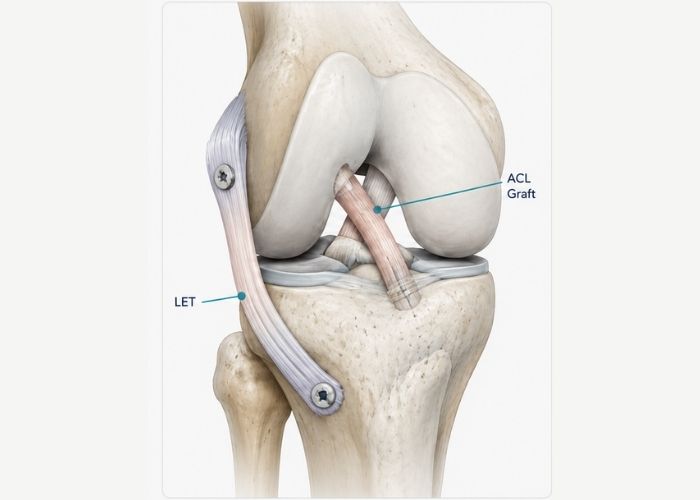
Recently, the BEAR Implant (Bridge-Enhanced ACL Restoration) has received significant attention as an alternative to traditional ACL reconstruction. The concept is appealing, allowing the ACL to heal itself with a little help from technology and an implant…but it is important to understand how it compares to the procedure that has successfully restored knee stability for decades.
For Dr. Benedict Nwachukwu, a fellowship-trained orthopedic sports medicine surgeon at Hospital for Special Surgery (HSS), the goal isn’t to recommend the newest procedure, it is to recommend the treatment that offers the best chance for long-term success based on each patient’s specific injury, goals, health, and activity level.
What happens when you tear your ACL?
The ACL is one of the primary ligaments that stabilizes the knee. It prevents excessive forward movement of the tibia (shinbone) and helps control rotational movements of the knee during activities like cutting, pivoting, landing, and sudden changes in direction.
ACL injuries are seen most commonly in these sports:
- Basketball
- Soccer
- Football
- Skiing
- Tennis
- Pickleball
- Running and fitness activities
- CrossFit
Most of our patients report hearing or feeling a “pop” in the knee, followed by swelling, pain, and a feeling that the knee wants to “give out.” Without a stable ACL, returning to cutting and pivoting sports is often difficult, if not impossible. Ignoring the problem, or not receiving the best treatment, may cause of additional injuries to the meniscus or cartilage.
Why can’t a torn ACL heal on its own?
Unlike many ligaments elsewhere in the body, the ACL has very little ability to heal naturally. The ligament sits inside the knee joint, where it is surrounded by synovial fluid. While this fluid helps lubricate the knee joint, it also prevents the blood clot formation that is necessary for healing after an ACL tear. As a result, most complete ACL tears do not reconnect or heal on their own.
PakarPBN
A Private Blog Network (PBN) is a collection of websites that are controlled by a single individual or organization and used primarily to build backlinks to a “money site” in order to influence its ranking in search engines such as Google. The core idea behind a PBN is based on the importance of backlinks in Google’s ranking algorithm. Since Google views backlinks as signals of authority and trust, some website owners attempt to artificially create these signals through a controlled network of sites.
In a typical PBN setup, the owner acquires expired or aged domains that already have existing authority, backlinks, and history. These domains are rebuilt with new content and hosted separately, often using different IP addresses, hosting providers, themes, and ownership details to make them appear unrelated. Within the content published on these sites, links are strategically placed that point to the main website the owner wants to rank higher. By doing this, the owner attempts to pass link equity (also known as “link juice”) from the PBN sites to the target website.
The purpose of a PBN is to give the impression that the target website is naturally earning links from multiple independent sources. If done effectively, this can temporarily improve keyword rankings, increase organic visibility, and drive more traffic from search results.